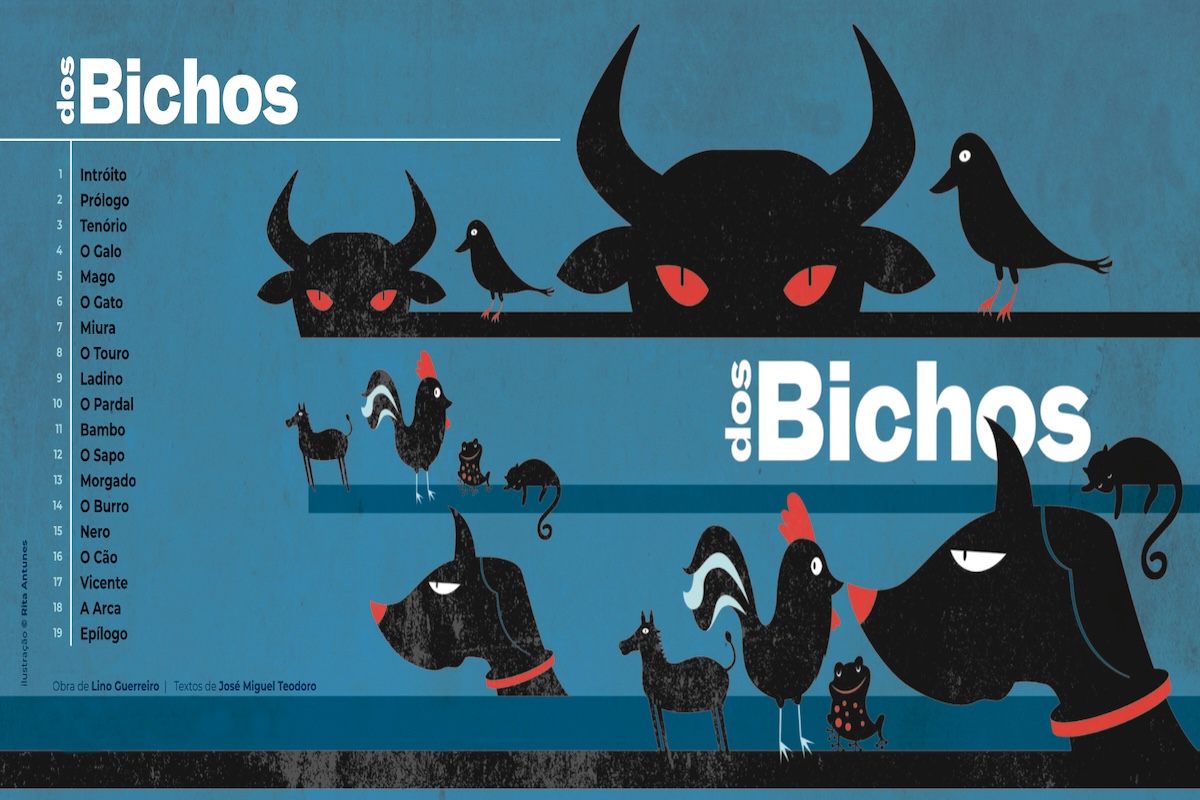
Texto de apresentação
Bichos, que o autor apresentou como uma colectânea de contos, teve a primeira edição em 1940. Em Coimbra, edição de autor, como tudo quanto Miguel Torga (1907-1995) publicou em vida, desde a obra de estreia (Ansiedade, 1928) à 19ª edição de Bichos, em 1995.
Na sua longuíssima carreira editorial, Bichos teve algumas variações, de vocabulário, mas também de conteúdo, com realce, aqui, para os dois novos “contos” – “Miura” e “O senhor Nicolau” – introduzidos na 2ª edição (1942) e o prefácio “Ao leitor”, que aparece na 5ª edição (1954).
Bichos constitui uma “leitura”, do autor, do seu próprio país, do seu tempo, e tem subjacente o desejo de que venha a mudar, tornando-se um país diferente. Quanto às personagens, bicho-animal e bicho-humano partilham características, nenhum é exclusivamente o que parece ser: o bicho-animal tem dimensão humana, interioridade de pessoa, é fulano ou sicrano que o leitor conhece; no bicho-humano, o autor põe em relevo a dimensão animal, que se conjuga com o que o faz pessoa.
Nos textos que seguem, elaborados a partir da 15ª edição da obra (Coimbra, 1985), dá-se o retrato dos bichos de Torga, adoptando-se na forma um tom e uma linguagem próximos da expressão do autor.
Intróito
Bichos, é o que somos todos, bichos.
Burro, sapo, touro, galo, o cão, o pardal, o corvo, Ramiro, a cigarra, o melro, Madalena, Nicolau, todos nós, mulheres e homens, tu, eu. Com nomes diferentes, mas todos bichos.
Com o poder da palavra e o fulgor do poeta, Miguel Torga convocou alguns deles, deu-lhes identidade e circunstância e inscreveu-os na literatura.
Com nome próprio, aqui se trazem num outro registo – em música:
Tenório, o Galo, Mago, o Gato, Miura, o Touro, Ladino, o Pardal, Bambo, o Sapo, Morgado, o Burro, Nero, o Cão, Vicente, o Corvo.
Fazendo uso da expressão de Torga, ao ouvinte, damos-lhe as boas-vindas ao portaló desta pequena Arca de Noé.
Tenório, o Galo
Uma força da natureza, o Tenório. Com vossa licença, don Juan Tenório.
Quando cantou pela primeira vez foi como se o mundo tivesse sido criado outra vez.
Já era diferente quando a cabecita assomou fora da casca do ovo – crista tesa, de galo com marca de semental.
No galinheiro e lá fora, macho ou fêmea, todos sabiam que era ele quem mandava. Sendo necessário, ele saberia defender, à força, a honra e o que era seu, pondo cada um no lugar e a concorrência fora de jogo. Como fez ao galo da vizinha, com uma tosa monumental.
Frangas, pitas, galinhas, novas e velhas, asadas ou desasadas, era tudo dele, levava-as a eito, as de casa e, podendo, também as da redondeza.
E o que ele cantava, o peito inchado, vaidoso: ao amanhecer, como competia, o toque de alvorada; à meia-noite, por exibição; pelo dia adiante, feito don Juan, lançando a rede ao elemento feminino da vizinhança – fraquezas de quem é forte, bonito e com tamanho poder de sedução.
Fazia já três anos que reinava sobre todo aquele gentio. Sem queixas, que se saiba, do galinheiro ou da patroa.
Porém…
De uma das últimas ninhadas, filho dele como os outros, tinha saído um galarote que prometia, dava nas vistas.
Que se acautelasse – havia galo novo a caminho!
…
Em Outubro, Tenório teve o fim dos galos velhos naquela casa. O mesmo do don Juan que o precedera, quando puseram outro no seu lugar.
Mago, o Gato
Quatro patas, pelo bem tratado, músculos, tendões e nervos capazes de se retesar para compor um salto – lá para fora, para a liberdade, como fazem os felinos.
Poder, podia, mas… e a vontade?
Mago, o gato, habituara-se àquilo, já não estranhava: o conforto da casa, os cobertores e almofadas, comidinha a horas, tardes de modorra e noites bem dormidas, a preguiça de todos os dias, os mimos e afagos da dona.
Ah!, sim, até cansava. Mas que havia de fazer? Culpa dela, da dona, que com bom trato o amolecera àquele ponto.
De vez em quando vinham-lhe umas ganas: ir-se embora, deixar tudo, aquilo não era vida. Mas, faltavam-lhe as forças, e ia ficando.
Os outros gatos lançavam-lhe provocações, algumas desfazendo no seu amor-próprio, insultos à dignidade de qualquer bicho. Aguentava; calhava achar que eram invejas, deixá-los falar!
Até um dia em que foi demais. Ofender não vale, meu menino! Que remédio, foi à luta.
Mas correu mal: o outro ganhou, e ele enterrou naquele momento o que ainda lhe restava de dignidade. Vencido, ferido e humilhado por um semelhante, tornava-se à dona: culpa dela ele já não ser o felino de outros tempos.
Outro, no lugar dele, desaparecia, não voltava àquela casa, renegando para sempre o conforto e a degradação que comportava viver ali; ele, não, voltava de livre vontade.
Remorsos? Cobardia? Ora, ora!
Miura, o Touro
Têm-no preso entre quatro paredes, mal pode mexer-se, o corpo e a indignação submetidos pela laje fria do cárcere.
Lá fora, emoção, palmas, música e gritos de gente, espectáculo! Na praça, bem no meio, o calvário de paixão e morte desenhado para o sacrifício dos toiros. Uma festa!
Miura será o terceiro a sair. Bravo, espera-se.
No curro, tolhido de movimentos, só a memória mitiga o desespero do ser livre que foi – a planície imensa, a linha do horizonte, muito fina, tão longe, o céu infinito, o sabor da água fria que se bebe, a nostalgia do tempo ilimitado da liberdade perdida.
Até que chega a sua vez, ditada pelo toque alegre do cornetim, a entrada do terceiro toiro festejada por aquela mancha compacta de gente, para lá do tapume redondo de tábuas, entre barreiras, nas galerias e bancadas de sol e sombra.
Já esquecido do paraíso, Miura tremia de cólera e angústia, desorientado. Novo toque para a lide começar – era de luta que se tratava. Já lhe acontecera, na campina ribatejana, bicho contra bicho, luta dura, mas leal; naquela arena não, era luta de mentira, o homem escondia-se, ludibriava o toiro, o ímpeto deste desfazendo-se contra um pano vermelho, investindo com garra, mas marrando em falso, uma, dez vezes, quantas mais?
Por um instante, quando homem e toiro lutaram com verdade, arremeteu sobre o trapaceiro, varando-o com uma cornada. Depois, o jogo viciado recomeçou, massacrando o corpo suado e ferido, o toiro perdido num desespero de morte. Voltasse a jogar-se limpo, outro homem cairia, como o primeiro, e até mais.
Mas… subitamente, Miura percebe, começa a perceber: por mais toureiros que desbaste, o triunfo nunca será seu, o vencedor será sempre o homem.
A ele, toiro de morte, resta, pois, o sacrifício, deixar-se sacrificar.
Faça-se, concluiu! E numa arremetida, num acto de vontade, o toiro avança, resoluto, para o estoque que lhe vai tirar a vida.
Ladino, o Pardal
Nove meses de Inverno e três de Inferno sofriam naquela terra as criaturas. Ladino, nem tanto.
Os outros pássaros, levava-os a aspereza do tempo, a doença, as artes do bicho-homem. Ele, não.
Astuto em novo, finório quando calhava, hipócrita muitas vezes, manhoso se era preciso, Ladino apresentava-se gordo e aconchegado, em terra de frio e miséria.
Um milagre? Nem milagre, nem acaso; sapiência, sim; saber viver, sim senhor!
O pardal tinha o instinto afinado para o que era preciso, a recomendar-lhe, a todo o momento, as regras da sobrevivência:
«Sê prudente, Ladino, tem cautela, foge dos perigos, deixa os riscos para os distraídos e para quem queira corrê-los.
Aprendeste alguma coisa com a experiência, não foi? Aproveita essa sabedoria, pardal, para te defenderes.
Os outros têm problemas? Deixa-os, que os resolvam. Queixam-se de ser pobres? Pois, que tenham paciência.»
Relho de velho, Ladino, o pardal, presumia-se de ser eterno: morrer, só acabando-se de todo o milho em Trás-os-Montes.
«No entretanto», dizia, «tratar da vidinha – sossego e papinho cheio é o principal; e basta!»
Bambo, o Sapo
O nome pode dizer muito de quem o carrega.
Ou muito pouco, como o de Bambo, o atarracado de pernas traseiras em dobradiça, de andar lento, a menear-se, como se dançasse.
Um andarilho, o senhor sapo, quem diria?
Estava-lhe na natureza, como hibernar de Outubro a Março, ou esconder- se durante o dia; ou, noite fora, sem pressas, banhar-se de luar, alheado do mundo, como os poetas.
Foi de vê-lo assim que tio Arruda se fez outro homem – aprendendo que há vida para além de comer e beber, cavar e resignar-se com a escuridão e a miséria, que um rústico pode ser gente.
Falou nisso aos outros da aldeia; cegos, como tio Arruda sempre fora, replicaram-lhe com bruxarias e magia negra, de artes do demónio oficiadas pelos sapos.
Não queriam ver? Deixá-los.
Quanto a eles, homem e sapo, entendiam-se em silêncio, tornando desnecessárias as palavras. Amorfo e apático na figura, Bambo era afinal um mestre do sentido da vida, que ensinou ao homem o entendimento e a comunhão com a natureza. Tio Arruda aprendeu mais:
a deslumbrar-se com as coisas simples, com a fecundação da terra, o germinar da semente, a beleza do orvalho na erva, ou o canto do rouxinol;
a deixar-se estar e olhar, perscrutando o inexplicado, adivinhando o segredo do que é complexo, conjugando o infinitamente pequeno com a imensidão de um céu estrelado;
o fascínio pelo mistério das causas primeiras e os fins últimos das coisas.
Um milagre!
Morgado, o Burro
Tinha gostado do demónio do homem mesmo antes de o ter como dono.
Depois, foram anos de vida dura que lhe deu, que para isso se quer um burro; dele (Morgado orgulhava-se disso) também teve o almocreve quanto precisou – até mais.
Mas, trazia-o bem comido e bebido, como precisava qualquer bicho.
Com um homem assim por perto, mesmo quando há perigo e a aflição é grande, vai-se seguro, à confiança. Como ia o burro, em noite medonha, por caminhos ruins, azougado com o peso da carga – apesar da ameaça dos lobos que os acossavam.
Mas, enganava-se em relação ao homem: no desespero da vida em perigo, se a besta marchava oprimida pelo medo, o almocreve ia na mesma – moeu o burro de pancada, para que os safasse dali.
Pior: Morgado identifica no homem sinais de fraqueza, que está disposto a tudo – e que vai entregar às feras quem sempre foi seu amigo, para salvar a própria vida.
Não ter o almocreve vergonha!
E lá vai ele, serra acima, a fugir, levando consigo a albarda – que, assim, não perdia tudo. O animal, abandonado aos lobos, que o levasse o diabo!
Nero, o Cão
Em fim de vida, os velhos têm destas coisas.
Desfiam-se episódios, conhecimentos que se fizeram, as maluquices dos primeiros anos, nevões e o frio que se teve, as festas no lombo, as humilhações, as patas na terra e nas fragas, monte abaixo, a côdea de pão, o caldo e um pedaço de toucinho em dias assinalados, o filho que se foi, a primeira grande hora da vida ao abocanhar uma presa, o dia em que lhe deram o nome. Até um certo peso na consciência, de coisas que se fizeram – pronto, fraquezas de perdigueiro!
O que aquele cão tinha sido. E agora, ali, um autêntico farrapo. Outro tomaria o seu lugar.
Deixava saudades? É possível. A patroa nova, vendo-o assim, não lhe deitara aquele olhar tão triste? Consolava-o, enfim… Em momentos como aquele, sabia bem!
De resto, nada.
À volta, como se não se desenrolasse ali aquela tragédia, a vida corria como sempre. E ele a morrer, sem a companhia de filho, de bicho ou gente.
Sozinho, finando-se: Nero, cão de caça distinto, oito anos de idade.
Vicente, o Corvo, ou a Arca
As comportas do céu tinham sido abertas há quarenta dias.
Durante quarenta dias e quarenta noites choveu torrencialmente, sem interrupção. Para castigar a iniquidade dos homens, Deus determinara aniquilar toda a vida na Terra. Mais tarde, chamaram ao episódio Dilúvio Universal.
Todavia, o Criador mandou que se salvasse um casal de cada espécie, para repovoar a Terra quando a divina cólera estivesse apaziguada.
Durante quarenta dias e quarenta noites, uma enorme caixa em madeira errou, à mercê dos elementos, sem rumo, por esse imenso oceano em que se transformara a Terra.
Dentro da Arca, Noé, o Patriarca de seiscentos anos, e toda a criação tremem de medo, não vá o Senhor arrepender-se de os ter poupado.
Mas, naquela massa anónima de desesperados, há um que não se submete: Vicente, o corvo negro. Inconformado com o procedimento de Deus, decide fugir daquela prisão. Naquele ser, nem a ameaça do castigo divino era suficiente para calar o anseio de ser livre.
Porém, o voo para a liberdade tinha os seus riscos: O-Que-Tudo-Manda não tolera a desobediência, muito menos a rebelião. Vicente sabia isso e, ao escolher, aceitara as consequências do seu acto.
E eis que o Todo-Poderoso põe em acção todos os recursos para castigo daquele que o desafiara. Num ápice, lá fora, com a Terra ainda coberta de água, um duelo opõe Vicente à fúria justiceira de Deus. Para quantos estão na Arca de Noé, o desfecho será a aniquilação do autor daquela ousadia.
…
Mas, em breve, aquele combate de morte toma outro rumo: nada podia vencer aquela vontade de ser livre. O Criador percebeu, e por isso ia ceder: pois, ao dar vida à sua criatura, Deus tinha-a reconhecido autónoma, livre!
Presentation Text
Bichos, which the author presented as a collection of short stories, was first published in 1940. It appeared in Coimbra as a self-published edition, like everything Miguel Torga (1907–1995) published during his lifetime, from his first work (Ansiedade, 1928) to the 19th edition of Bichos, in 1995.
Over its very long publishing history, Bichos underwent several changes, both in vocabulary and in content. Of particular note here are the two new “stories” – “Miura” and “O senhor Nicolau” – introduced in the 2nd edition (1942), and the preface “Ao leitor”, which first appeared in the 5th edition (1954).
Bichos constitutes the author’s own “reading” of his country and his time, and underlying it is the desire that the country might change and become something different. As for its characters, animal-creature and human-creature share characteristics; neither is exclusively what it appears to be. The animal-creature has a human dimension, the inner life of a person, someone the reader might know; in the human-creature, the author brings out the animal dimension, combining it with what makes that being a person.
In the texts that follow, based on the 15th edition of the work (Coimbra, 1985), Torga’s creatures are portrayed in a tone and language that seek to remain close to the author’s own expression.
Prelude
Bichos, that is what we all are: creatures.
Donkey, toad, bull, rooster, the dog, the sparrow, the crow, Ramiro, the cicada, the blackbird, Madalena, Nicolau, all of us, women and men, you, me. With different names, but all creatures.
With the power of words and the brilliance of the poet, Miguel Torga summoned some of them, gave them identity and circumstance, and inscribed them in literature.
Here, bearing their own names, they are brought into another medium – music:
Tenório, o Galo, Mago, o Gato, Miura, o Touro, Ladino, o Pardal, Bambo, o Sapo, Morgado, o Burro, Nero, o Cão, Vicente, o Corvo.
Borrowing Torga’s own expression, we welcome the listener aboard this small Noah’s Ark.
Tenório, o Galo
A force of nature, Tenório. With your permission, Don Juan Tenório.
When he crowed for the first time, it was as though the world had been created all over again.
He was already different when his little head first appeared outside the eggshell – crest held high, a rooster bearing the mark of a breeding male.
In the henhouse and beyond it, male or female, everyone knew that he was the one in charge. If necessary, he knew how to defend by force his honour and what belonged to him, putting everyone in their place and taking the competition out of the game. As he did with the neighbour’s rooster, giving him a monumental thrashing.
Pullets, young hens, old hens, winged or otherwise, they were all his; he took them one after another, those at home and, whenever he could, those in the surrounding area as well.
And how he crowed, chest swollen with pride: at dawn, as was proper, sounding reveille; at midnight, merely to show off; throughout the day, playing Don Juan and casting his net over the female population of the neighbourhood – the weaknesses of one who is strong, handsome and possessed of such powers of seduction.
For three years he had reigned over that entire population. With no complaints, as far as anyone knew, from either the henhouse or its mistress.
And yet…
From one of the latest broods, one of his sons like all the others, a young cockerel had emerged who showed promise and attracted attention.
He had better beware – a new rooster was on his way!
…
In October, Tenório met the fate of old roosters in that household. The same fate as the Don Juan who had preceded him, when another was put in his place.
Mago, o Gato
Four paws, well-groomed fur, muscles, tendons and nerves capable of tightening for a leap – out there, towards freedom, as felines do.
He could, of course… but did he want to?
Mago, the cat, had grown used to it all and no longer found anything strange in it: the comfort of the house, blankets and cushions, food served on time, languid afternoons and nights of sound sleep, the daily laziness, his mistress’s caresses and affection.
Ah, yes, it could even become tiresome. But what was he to do? It was her fault, his mistress’s, for treating him so well that she had softened him to this point.
From time to time he felt an urge: to leave, abandon everything, because this was no life at all. But he lacked the strength, and so he stayed.
The other cats taunted him, some striking at his pride, insults to the dignity of any creature. He endured them; perhaps they were merely jealous, so let them talk!
Until one day it became too much. There are limits to insults, my boy! There was nothing for it: he fought.
But it went badly. The other cat won, and at that moment Mago buried whatever dignity he still had left. Defeated, wounded and humiliated by one of his own kind, he returned to his mistress: it was her fault that he was no longer the feline he had once been.
Another in his place would have disappeared, never returning to that house, forever renouncing the comfort and degradation that came with living there; but not him – he returned of his own free will.
Remorse? Cowardice? Oh, come now!
Miura, o Touro
They keep him imprisoned between four walls, barely able to move, his body and his indignation subdued by the cold stone of his prison.
Outside: excitement, applause, music and the cries of the crowd – a spectacle! In the arena, at its very centre, the calvary of passion and death prepared for the sacrifice of the bulls. A celebration!
Miura will be the third to emerge. Brave, they hope.
In the pen, his movements constrained, only memory eases the despair of the free creature he once was – the immense plain, the thin line of the horizon so far away, the infinite sky, the taste of cold water, the longing for the limitless time of lost freedom.
At last his turn comes, announced by the cheerful call of the trumpet, the entrance of the third bull celebrated by that dense mass of people beyond the circular wooden barrier, among the barriers, galleries and stands of sun and shade.
The paradise already forgotten, Miura trembles with rage and anguish, disoriented. Another call announces the beginning of the fight – for a fight is what this is supposed to be. He has fought before, on the Ribatejo plains, animal against animal, a hard but honest struggle; not so in this arena. Here the fight is false. The man hides, deceives the bull, whose momentum is spent against a red cloth, charging fiercely but striking nothing, once, ten times – how many more?
For one moment, when man and bull truly fought, Miura charged the deceiver and gored him. Then the rigged game began again, tormenting his sweating, wounded body, the bull lost in the despair of death. Were the game to become fair again, another man would fall, like the first, and perhaps more.
But… suddenly Miura understands, begins to understand: however many bullfighters he may bring down, victory will never be his; the winner will always be man.
For him, a bull destined for death, only sacrifice remains: to allow himself to be sacrificed.
So be it, he concludes! And in a final charge, an act of will, the bull advances resolutely towards the sword that will take his life.
Ladino, o Pardal
Nine months of Winter and three of Hell were what creatures endured in that land. Ladino, less so.
The other birds were carried off by the harshness of the weather, by illness, by the devices of the human-creature. Not him.
Clever when young, shrewd when it suited him, often hypocritical, crafty when necessary, Ladino remained plump and comfortable in a land of cold and misery.
A miracle? Neither miracle nor chance; wisdom, yes; knowing how to live, indeed!
The sparrow had an instinct finely tuned to what was required, constantly reminding him of the rules of survival:
«Be prudent, Ladino, be careful, avoid danger, leave risks to the distracted and to those who wish to take them.
You have learnt something from experience, haven’t you? Make use of that wisdom, sparrow, to protect yourself.
Others have problems? Leave them to solve them. They complain that they are poor? Well, they will simply have to endure it.»
A hardened old fellow, Ladino the sparrow imagined himself eternal: he would die only when every last grain of maize in Trás-os-Montes was gone.
«In the meantime,» he would say, «look after one’s own affairs – peace and a full belly are what matter; and that is enough!»
Bambo, o Sapo
A name can say a great deal about the one who bears it.
Or very little, as in the case of Bambo, the squat fellow with hind legs like hinges, walking slowly and swaying as though he were dancing.
A wanderer, Mr Toad – who would have thought it?
It was in his nature, just like hibernating from October to March, or hiding during the day; or, through the night, without haste, bathing in moonlight, detached from the world, like poets.
It was by seeing him like this that Uncle Arruda became a different man – learning that there is life beyond eating and drinking, digging the earth and resigning oneself to darkness and misery; that even a rustic man can be fully human.
He spoke of it to the others in the village; blind, as Uncle Arruda himself had always been, they answered him with talk of witchcraft and black magic, demonic arts performed by toads.
They did not want to see? Let them be.
As for the two of them, man and toad, they understood each other in silence, making words unnecessary. Amorphous and apathetic in appearance, Bambo was in fact a master of the meaning of life, teaching the man understanding and communion with nature. Uncle Arruda learnt more:
to marvel at simple things, at the fertilisation of the earth, the germination of the seed, the beauty of dew upon the grass, or the song of the nightingale;
to remain still and look, probing the unexplained, sensing the secret of what is complex, bringing together the infinitely small and the immensity of a star-filled sky;
the fascination with the mystery of first causes and the ultimate purposes of things.
A miracle!
Morgado, o Burro
He had taken a liking to that devil of a man even before having him as his owner.
Afterwards came years of hard work imposed upon him, for that is what a donkey is for; and from him – Morgado took pride in this – the muleteer had also received everything he needed, and more.
But he kept the donkey well fed and watered, as every creature needed to be.
With a man like that nearby, even when danger threatens and distress is great, one travels safely, in trust. As the donkey did on that dreadful night, along treacherous paths, burdened by the weight of his load – despite the threat of the wolves pursuing them.
But he had been mistaken about the man: in the desperation of mortal danger, while the beast struggled onward oppressed by fear, the muleteer was just as frightened – and beat the donkey mercilessly so that he might get them out of there.
Worse still: Morgado recognises signs of weakness in the man, realises that he is prepared to do anything – that he will surrender to the beasts the one who has always been his friend, merely to save his own life.
Shame on the muleteer!
And off he goes, fleeing up the mountain, taking the pack-saddle with him – so that at least he would not lose everything. As for the animal, abandoned to the wolves, the devil could take him!
Nero, o Cão
At the end of life, the old are prone to such things.
Episodes are reeled off, acquaintances once made, the follies of the early years, snowstorms and the cold endured, beatings on the back, humiliations, paws on earth and rock, down the mountainside, a crust of bread, broth and a piece of bacon on special days, the son who left, the first great moment of life when he seized his first prey, the day they gave him his name. Even a certain weight upon the conscience, for things once done – well, the weaknesses of a hunting dog!
What that dog had once been. And now, there, nothing but a rag. Another would take his place.
Would he be missed? Perhaps. Had the new mistress, seeing him like this, not given him that sad look? It comforted him, at least… At moments like this, it felt good.
Apart from that, nothing.
Around him, as though no tragedy were unfolding there, life went on as always. And he was dying, without the company of child, animal or human being.
Alone, fading away: Nero, distinguished hunting dog, eight years of age.
Vicente, o Corvo, ou a Arca
The floodgates of heaven had been open for forty days.
For forty days and forty nights, rain had fallen torrentially without interruption. To punish the iniquity of humankind, God had determined to annihilate all life on Earth. Later, the episode would be called the Great Flood.
Nevertheless, the Creator commanded that one pair of every species be saved, so that the Earth might be repopulated once divine wrath had subsided.
For forty days and forty nights, an enormous wooden box drifted at the mercy of the elements, without direction, across the vast ocean into which the Earth had been transformed.
Inside the Ark, Noah, the six-hundred-year-old Patriarch, and all creation tremble with fear lest the Lord regret having spared them.
Yet among that anonymous mass of desperate beings there is one who refuses to submit: Vicente, the black crow. Unable to accept God’s actions, he decides to escape from that prison. In that creature, not even the threat of divine punishment is enough to silence the longing to be free.
But the flight towards freedom has its risks: He-Who-Commands-All does not tolerate disobedience, still less rebellion. Vicente knows this and, in making his choice, accepts the consequences of his act.
And so the Almighty sets in motion every means at His disposal to punish the one who has defied Him. In an instant, outside, with the Earth still covered in water, a duel pits Vicente against the righteous fury of God. To all those aboard Noah’s Ark, the outcome can only be the annihilation of the one responsible for such audacity.
…
But before long, that mortal struggle takes another course: nothing could defeat that will to be free. The Creator understood, and so He was going to yield: for in giving life to His creature, God had acknowledged it as autonomous, free!
Piccolo
Flute 1-2
Oboe 1-2
Bassoon 1-2
E♭ clarinet
B♭ clarinet 1-3
Bass clarinet
Soprano saxophone
Alto saxophone 1-2
Tenor saxophone 1-2
Baritone saxophone
Cornet
Flugelhorn
B♭ trumpet 1-3
F horn 1-4
Trombone 1-3
Bass trombone
Euphonium 1-2
Tuba
Timpani
Glockenspiel
Marimba
Bass drum
Alfaia
Snare drum
Floor tom
Bodhran (opt. adufe)
Pair of cymbals
Ride cymbal
Cabasa
Guiro
Piano
- Performance Orquestra de Sopros Metropolitana, João Malha (conductor) [ n/l ] (Lisbon, Portugal) [ n/e ] – 16 December 2025
- Release Orquestra de Sopros Metropolitana, Carlos Reinaldo Guerreiro (conductor) [ n/l ] (Lisbon, Portugal) [ dos Bichos ] – 29 July 2025
- Performance Ensemble de Sopros e Percussão da Metropolitana, Lino Guerreiro (conductor) [ Fórum Municipal Luísa Todi ] (Setúbal, Portugal) [ Jovens Solistas ] – 13 June 2021
- Performance Ensemble de Sopros e Percussão da Metropolitana, Lino Guerreiro (conductor) [ n/l ] (Lisbon, Portugal) [ n/e ] – 12 June 2021
- Performance Ensemble de Sopros e Percussão da Metropolitana, Lino Guerreiro (conductor) [ Sociedade Filarmónica União e Capricho Olivalense (SFUCO) ] (Lisbon, Portugal) [ Jovens Solistas ] – 05 June 2021
- Performance Orquestra de Sopros Metropolitana, Carlos Reinaldo Guerreiro (conductor) [ n/l ] (Lisbon, Portugal) [ n/e ] – 07 April 2019
- Premiere Orquestra de Sopros Metropolitana, Carlos Reinaldo Guerreiro (conductor) [ Main Auditorium – Centro Cultural de Belém ] (Lisbon, Portugal) [ n/e ] – 21 February 2016

(…) És, pois, dono como eu deste livro, e, ao cumprimentar-te à entrada dele, nem pretendo sugerir-te que o leias com a luz da imaginação acesa, nem atrair o teu olhar para a penumbra da sua simbologia. Isso não é comigo, porque nenhuma árvore explica os seus frutos, embora goste que lhos comam. Saúdo-te apenas nesta alegria natural, contente por ter construído uma barcaça onde a nossa condição se encontrou, e onde poderemos um dia, se quiseres, atravessar juntos o Letes, que é, como sabes, um dos cinco rios do inferno, cujas águas bebem as sombras, fazendo-as esquecer o passado.
Teu Miguel Torga